“Nusrat is now the symbol of the family name and its tradition. He is the prestige that has been brought to our house. His popularity and the respect he commands has immortalized our family. Nusrat is a living legend. I think of only one thing: that may Allah reward him more and more with greater honour—honours such as have not been received by any other artiste. We consider his honour to be ours and his unprecedented popularity to be our own. Our hearts beat for each other; we feel each other’s pain and pleasure. We may have different names and bodies, but our hearts beat as one.”
— Farrukh Fateh Ali Khan, on his brother Nusrat
The Man Behind the Music
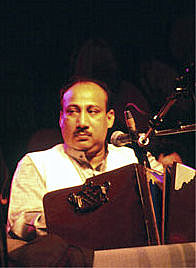
If NFAK was the thunder that entranced the world, Farrukh was the rain of melody that followed.
Farrukh Fateh Ali Khan (December 25, 1952 – September 9, 2003) was the younger brother of Ustad Nusrat Fateh Ali Khan and one of only two members who remained with the Qawwali party throughout its entire 26-year existence from 1971 to 1997.
He was the:
- Son of Ustad Fateh Ali Khan
- Nephew of Ustad Mubarak Ali Khan
- Father of Rahat Nusrat Fateh Ali Khan
Harmonium Raj Sahib – King of the Harmonium
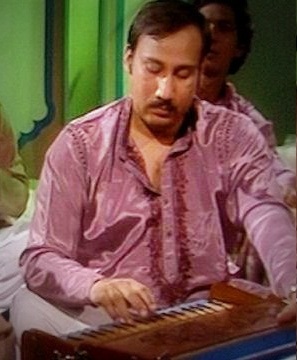
Farrukh played the lead harmonium and provided accompanying vocals. His musical talents were extraordinary:
- Mastery of all scales – He could play in any key effortlessly
- Instant transitions – His ability to switch a tune at a moment’s notice was unmatched
- Composition – Many of the qawwalis sung by the party were actually composed by Farrukh
While accompanying Nusrat to England, he became widely known as Harmonium Raj Sahib (King of the Harmonium). This title, bestowed upon him by audiences in the UK, recognized his supreme mastery of the instrument.
The Unsung Hero
His talents and accomplishments often went unrecognized due to playing in the shadow of his legendary brother. However, Nusrat himself frequently acknowledged Farrukh’s contributions:
In an interview with Pakistan Television in 1989, Nusrat revealed that very often the tunes of the qawwalis sung by the party were composed by Farrukh.
Farrukh is credited as the music composer in several of the group’s albums, including the acclaimed Shahenshah.
The Driving Soul of the Party
Farrukh Fateh Ali Khan was always considered more mature than Nusrat. He was the man who always knew what was best for the party. During their initial years of struggle, when even Nusrat broke down with despair, it was Farrukh who kept the hope alive.
Once NFAK rightly described Farrukh as his eyes, with which the world became a lot more beautiful to look upon.
He was not just a musician but the emotional anchor of the ensemble—always ready to cover for others’ mistakes, brilliant at tune transitions, and quick to beautify Nusrat’s improvisations with his own “textured alaap.”
Very often during performances, Nusrat would praise Farrukh by nodding his head in approval or sometimes even exclaiming “Subhaan Allah!”
Father and Son
One of the most touching stories about Farrukh speaks to the bond between the brothers:
There came a time when a tearful Nusrat asked Farrukh to give Rahat to him as a son. And Farrukh replied: “He was always your son first.”
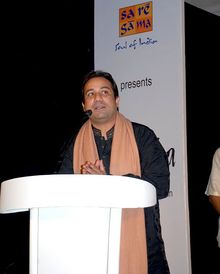
This selfless act allowed Rahat Nusrat Fateh Ali Khan to be raised and trained directly by his uncle, eventually becoming his successor and carrying forward the family legacy to new generations.
Legacy
Farrukh remained a member of the party even after Nusrat’s death in 1997, when his son Rahat took over leadership. He continued to support and guide his son until his own passing on September 9, 2003.
Though he played in the shadow of one of the greatest vocalists in history, those who know Qawwali understand that without Farrukh’s harmonium, without his compositions, and without his steady presence—the magic of the party would not have been the same.
Learn more about the legendary ensemble
Explore The Ensemble →