Meet the Party Members
Discover the extraordinary musicians who formed the legendary Humnawa – the voices and instruments behind the greatest Qawwali ensemble in history.
“The composition of Khan’s ensemble, called a ‘party’ or ‘Humnawa’ in Urdu, changed over its 26 years. But the core remained—a brotherhood of voices and instruments that together created something transcendent.”
The Party (Humnawa)
The Qawwali party was more than a musical ensemble; it was a spiritual brotherhood bound by tradition, devotion, and an unwavering commitment to the art. Nusrat led this party from 1971 until his passing in 1997, transforming it into the most celebrated Qawwali group in history.
Party Composition (circa 1983)
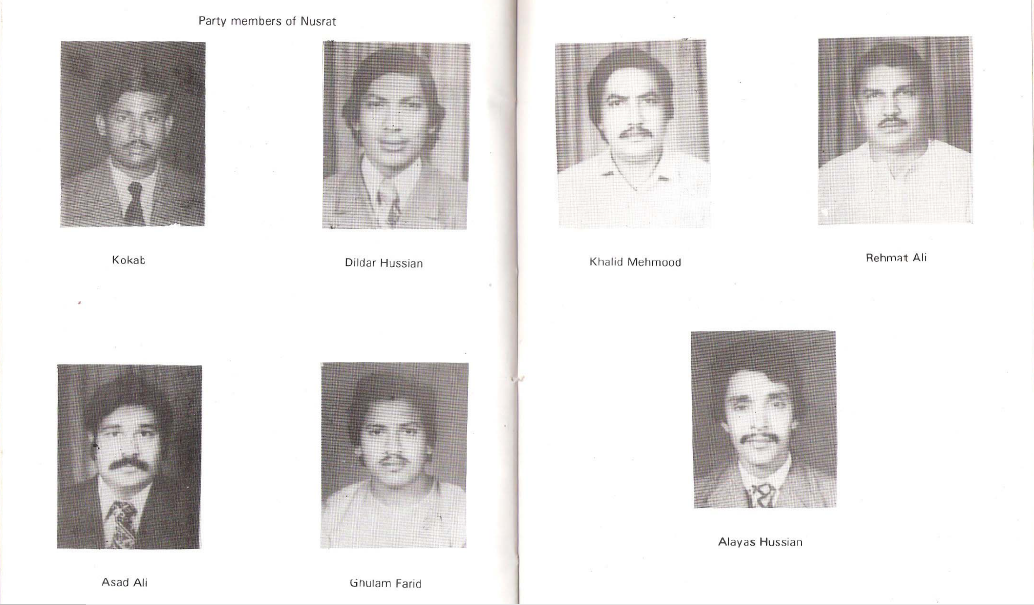
The party typically consisted of 10-12 members, each with a specific role:
- Mujahid Mubarak Ali Khan – Khan’s first cousin, vocals
- Farrukh Fateh Ali Khan – Khan’s brother, vocals and lead harmonium
- Rehmat Ali – Vocals and second harmonium
- Maqsood Hussain – Vocals
- Rahat Nusrat Fateh Ali Khan – Khan’s nephew and pupil, vocals
- Dildar Hussain – Percussion
- Majawar Abbas – Mandolin, guitar, and chorus/handclapping
- Mohammed Iqbal Naqvi – Secretary of the party, chorus/handclapping
- Asad Ali – Khan’s cousin, chorus/handclapping
- Ghulam Farid – Chorus/handclapping
- Kaukab Ali – Chorus/handclapping
One significant member who does not appear on this list is Atta Fareed. For many years, he alternated with Rehmat Ali on vocals and second harmonium. He is easily identifiable in videos since he plays the harmonium left-handed.
The Instruments
This snapshot is non-representative in one respect: harmoniums were usually the only melodic instruments. Only rarely were instruments like mandolin or guitar used.
The traditional Qawwali setup consisted of:
- Harmonium – The primary melodic accompaniment, with the lead harmonium following and supporting the vocalist
- Tabla/Dhamma-Jori – The percussion that drives the rhythm, played with a distinctive “Ata Wala” style
- Handclapping (Taali) – The rhythmic foundation provided by the chorus
Key Members
Farrukh Fateh Ali Khan – The Heart of the Party
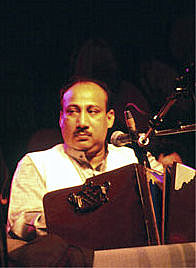
Farrukh Fateh Ali Khan (December 25, 1952 – September 9, 2003) was the younger brother of Nusrat and one of only two people who remained members of the party throughout its entire 26-year existence.
He played the lead harmonium and provided accompanying vocals. His talent to play in all scales and his ability to switch a tune at a moment’s notice were arguably the best in his profession. While accompanying Nusrat to England, he became widely known as Harmonium Raj Sahib (King of the Harmonium).
Read more about Farrukh Fateh Ali Khan →
Rahat Fateh Ali Khan – The Heir
Rahat Fateh Ali Khan (born 1974) is the son of Farrukh and nephew of Nusrat. He was trained by his uncle in the art of classical music and Qawwali from a very young age.
Rahat gave his first public performance at the age of ten or eleven, when he toured the UK with his uncle in 1985. After Nusrat’s passing in 1997, Rahat took over the leadership of the party—a mantle he carries to this day.
Read more about Rahat Fateh Ali Khan →
Dildar Hussain – The Rhythm Master
Ustad Dildar Hussain was born in 1957 in Kasoor, Pakistan. Along with Farrukh Fateh Ali Khan, Dildar had been a member of the party since its formation in 1971.
He learned tabla from Ustad Allah Rakha Khan—father and teacher of Ustad Zakir Hussain. Dildar does not play the traditional tabla but instead plays a combination of “jori” as the treble and “dhamma” as the bass to create a deeper, warmer sound.
Read more about Dildar Hussain →
The Musical Legacy
The members of the party were not just musicians—they were custodians of a 600-year tradition. Their synergy with Nusrat created a sound that transcended cultural boundaries and introduced millions around the world to the ecstatic power of Qawwali.
Explore the Qawwal Family Tree → to understand the remarkable lineage that produced such extraordinary artists.
Courtesy: Wikipedia and various sources
